Primes p such that p + 4 is a semiprime
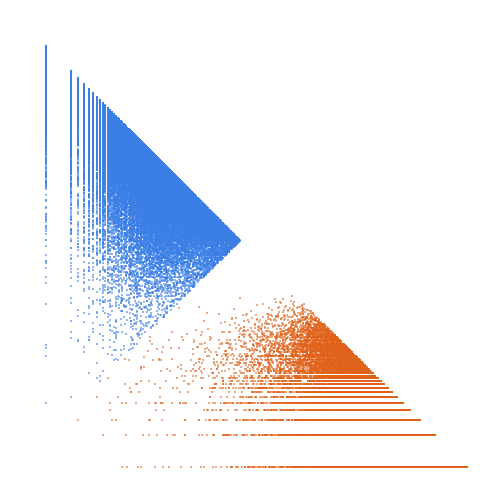
Open in the 3-D viewerA289250 on the OEIS
| Terms | 100,000 (n = 1 … 100,000) |
|---|---|
| Decomposable (a > 2d) | 99,995 |
| Level class, k > L | 34,605 · 34.61 % |
| Weight class, k ≤ L | 65,390 · 65.39 % |
| Ties, k = L | 22 |
| On the level line L = 1 | 10,445 |
| Forced level, l ≤ d² | 49 |
| Range of a(n) | 2 … 5,623,789 |
| Range of the jump d | 2 … 750 |
| Largest weight k, level L | 5,623,591, 1,872,845 |
223 different gaps occur, from 2 to 750; the level share is 34.61 %; L = 1 holds 30 % of the level class.
The decomposition
Every term of a strictly increasing sequence is written a(n) = k(n)·L(n) + d(n): the jump d = a(n+1) − a(n), the weight k the least divisor of a − d greater than d, the level L = (a − d)/k. A term decomposes when a > 2d; it is in the level class when k > L and in the weight class when k ≤ L. See decompwlj.com and arXiv:0711.0865, or how it works, with worked examples and a live one.