a(n) = 3*n*(n + 3)/2
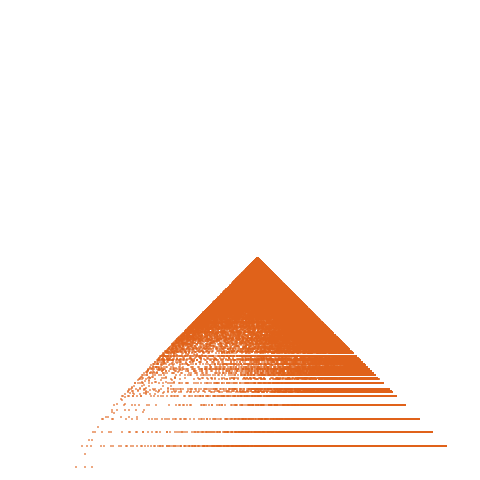
Open in the 3-D viewerA140091 on the OEIS
| Terms | 100,000 (n = 0 … 99,999) |
|---|---|
| Decomposable (a > 2d) | 99,996 |
| Level class, k > L | 99,996 · 100.00 % |
| Weight class, k ≤ L | 0 · 0.00 % |
| Ties, k = L | 0 |
| On the level line L = 1 | 3 |
| Forced level, l ≤ d² | 99,996 |
| Range of a(n) | 0 … 15,000,149,997 |
| Range of the jump d | 6 … 300,003 |
| Largest weight k, level L | 4,999,750,001, 49,768 |
Every gap is different, from 6 to 300,003; every decomposable term is forced level (l <= d^2).
SHA-256 of the CSV decompwlj_A140091.csv, checked before it is saved: 18d1aab47b36cb36f88dd44d36f50b1918e7dc049da0f005ca5a9de4d359c1b6 (all of them: sha256.txt, for sha256sum -c)
The decomposition
Every term of a strictly increasing sequence is written a(n) = k(n)·L(n) + d(n): the jump d = a(n+1) − a(n), the weight k the least divisor of a − d greater than d, the level L = (a − d)/k. A term decomposes when a > 2d; it is in the level class when k > L and in the weight class when k ≤ L. See decompwlj.com and arXiv:0711.0865, or how it works, with worked examples and a live one.