Belgian-1 numbers
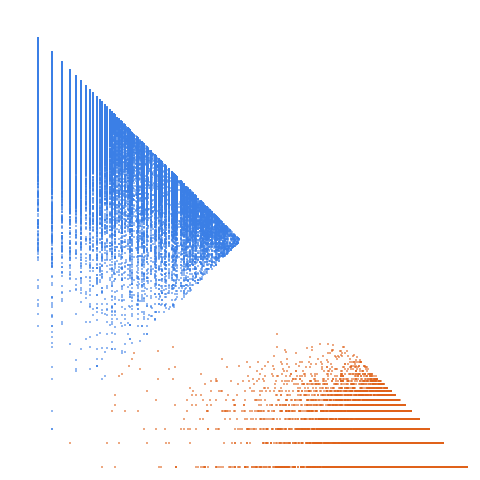
Open in the 3-D viewerA106439 on the OEIS
| Terms | 100,000 (n = 1 … 100,000) |
|---|---|
| Decomposable (a > 2d) | 99,998 |
| Level class, k > L | 17,935 · 17.94 % |
| Weight class, k ≤ L | 82,063 · 82.06 % |
| Ties, k = L | 27 |
| On the level line L = 1 | 9,012 |
| Forced level, l ≤ d² | 11 |
| Range of a(n) | 1 … 513,611 |
| Range of the jump d | 1 … 98 |
| Largest weight k, level L | 513,509, 256,776 |
66 different gaps occur, from 1 to 98; the level share is 17.94 %; L = 1 holds 50 % of the level class.
SHA-256 of the CSV decompwlj_A106439.csv, checked before it is saved: 6071f07463435acc9a8ed6a78c8d2c781c24459810919e7899ac78bfa16a6ec6 (all of them: sha256.txt, for sha256sum -c)
The decomposition
Every term of a strictly increasing sequence is written a(n) = k(n)·L(n) + d(n): the jump d = a(n+1) − a(n), the weight k the least divisor of a − d greater than d, the level L = (a − d)/k. A term decomposes when a > 2d; it is in the level class when k > L and in the weight class when k ≤ L. See decompwlj.com and arXiv:0711.0865, or how it works, with worked examples and a live one.