Numbers m that are the hypotenuse of exactly 22 distinct integer-sided right triangles, i.e., m^2 can be written as a sum of two squares in 22 ways
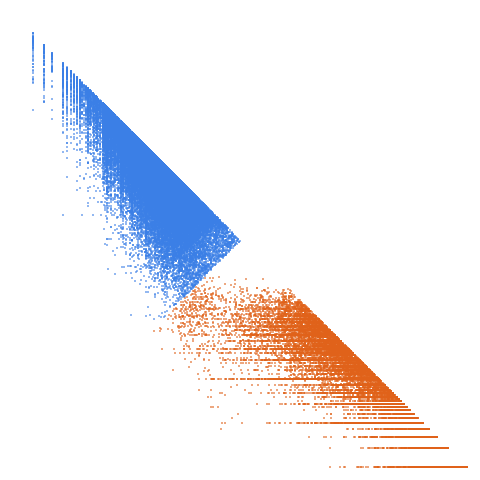
Open in the 3-D viewerA097103 on the OEIS
| Terms | 100,000 (n = 1 … 100,000) |
|---|---|
| Decomposable (a > 2d) | 99,999 |
| Level class, k > L | 25,672 · 25.67 % |
| Weight class, k ≤ L | 74,327 · 74.33 % |
| Ties, k = L | 4 |
| On the level line L = 1 | 1,430 |
| Forced level, l ≤ d² | 369 |
| Range of a(n) | 5,525 … 16,169,225 |
| Range of the jump d | 1 … 3,900 |
| Largest weight k, level L | 16,166,747, 8,061,637 |
848 different gaps occur, from 1 to 3,900; the level share is 25.67 %.
The decomposition
Every term of a strictly increasing sequence is written a(n) = k(n)·L(n) + d(n): the jump d = a(n+1) − a(n), the weight k the least divisor of a − d greater than d, the level L = (a − d)/k. A term decomposes when a > 2d; it is in the level class when k > L and in the weight class when k ≤ L. See decompwlj.com and arXiv:0711.0865, or how it works, with worked examples and a live one.