Primes of form x^2+6*y^2
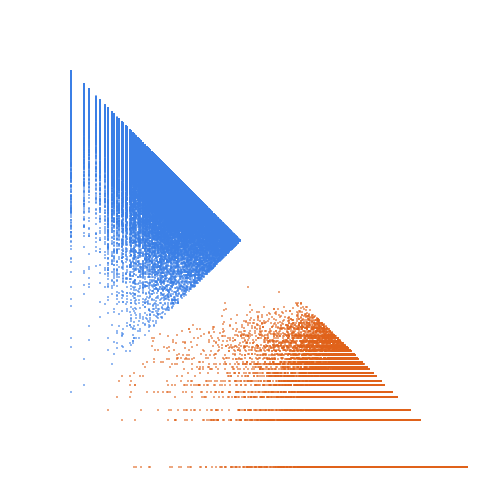
Open in the 3-D viewerA033199 on the OEIS
| Terms | 100,000 (n = 1 … 100,000) |
|---|---|
| Decomposable (a > 2d) | 99,998 |
| Level class, k > L | 39,510 · 39.51 % |
| Weight class, k ≤ L | 60,488 · 60.49 % |
| Ties, k = L | 23 |
| On the level line L = 1 | 17,008 |
| Forced level, l ≤ d² | 49 |
| Range of a(n) | 7 … 5,807,719 |
| Range of the jump d | 6 … 528 |
| Largest weight k, level L | 5,807,227, 829,405 |
60 different gaps occur, from 6 to 528; the level share is 39.51 %; L = 1 holds 43 % of the level class.
SHA-256 of the CSV decompwlj_A033199.csv, checked before it is saved: e1159d66b815926e56551ff1c4feb9edb190cf2e7ee7259976ec546b4d8deed5 (all of them: sha256.txt, for sha256sum -c)
The decomposition
Every term of a strictly increasing sequence is written a(n) = k(n)·L(n) + d(n): the jump d = a(n+1) − a(n), the weight k the least divisor of a − d greater than d, the level L = (a − d)/k. A term decomposes when a > 2d; it is in the level class when k > L and in the weight class when k ≤ L. See decompwlj.com and arXiv:0711.0865, or how it works, with worked examples and a live one.