The binary numbers (or binary words, or binary vectors, or binary expansion of n): numbers written in base 2
Open in the 3-D viewerA007088 on the OEIS
| Terms | 65,535 (n = 0 … 65,534) |
|---|---|
| Decomposable (a > 2d) | 65,519 |
| Level class, k > L | 8,298 · 12.67 % |
| Weight class, k ≤ L | 57,221 · 87.33 % |
| Ties, k = L | 1 |
| On the level line L = 1 | 2,538 |
| Forced level, l ≤ d² | 367 |
| Range of a(n) | 0 … 1,111,111,111,111,110 |
| Range of the jump d | 1 … 888,888,888,888,889 |
| Largest weight k, level L | 1,111,111,111,110,109, 370,370,370,370,333 |
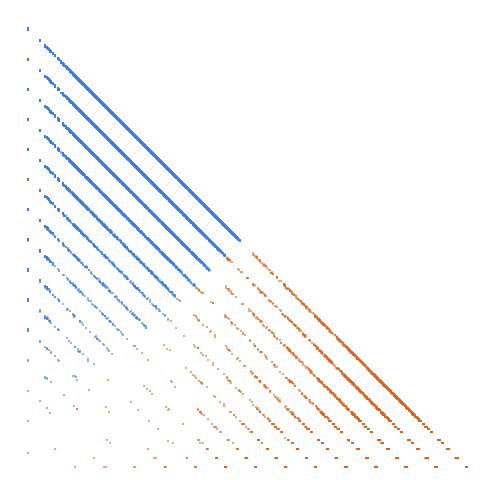
n in binary, read in decimal. The gap is (8*10^j + 1)/9 = 1, 9, 89, 889, ... where j counts the trailing 1 bits of n: sixteen values here, and the plane splits into clean diagonal lines. Capped at 65,535 terms, since a(65,536) = 10^16 passes 2^53.
The decomposition
Every term of a strictly increasing sequence is written a(n) = k(n)·L(n) + d(n): the jump d = a(n+1) − a(n), the weight k the least divisor of a − d greater than d, the level L = (a − d)/k. A term decomposes when a > 2d; it is in the level class when k > L and in the weight class when k ≤ L. See decompwlj.com and arXiv:0711.0865, or how it works, with worked examples and a live one.