Numbers that are the sum of 2 distinct nonzero squares
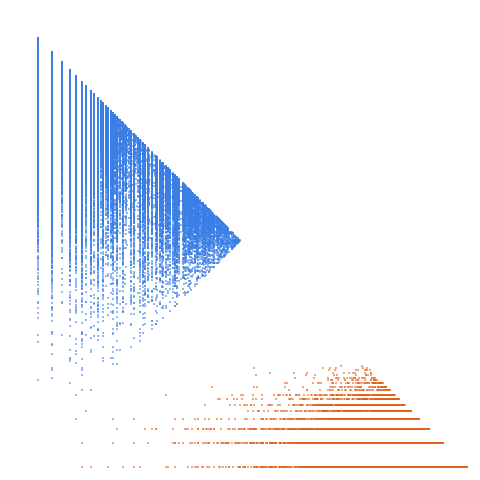
Open in the 3-D viewerA004431 on the OEIS
| Terms | 100,000 (n = 1 … 100,000) |
|---|---|
| Decomposable (a > 2d) | 99,999 |
| Level class, k > L | 15,977 · 15.98 % |
| Weight class, k ≤ L | 84,022 · 84.02 % |
| Ties, k = L | 15 |
| On the level line L = 1 | 6,152 |
| Forced level, l ≤ d² | 4 |
| Range of a(n) | 5 … 449,105 |
| Range of the jump d | 1 … 34 |
| Largest weight k, level L | 449,051, 224,544 |
x^2 + y^2 with 0 < x < y. The plane is that of all sums of two squares (15.98 % level against 15.95 %). The level share is 15.98 %; L = 1 holds 39 % of the level class.
The decomposition
Every term of a strictly increasing sequence is written a(n) = k(n)·L(n) + d(n): the jump d = a(n+1) − a(n), the weight k the least divisor of a − d greater than d, the level L = (a − d)/k. A term decomposes when a > 2d; it is in the level class when k > L and in the weight class when k ≤ L. See decompwlj.com and arXiv:0711.0865, or how it works, with worked examples and a live one.