A Beatty sequence: a(n) = floor(n*(1+1/sqrt(2)))
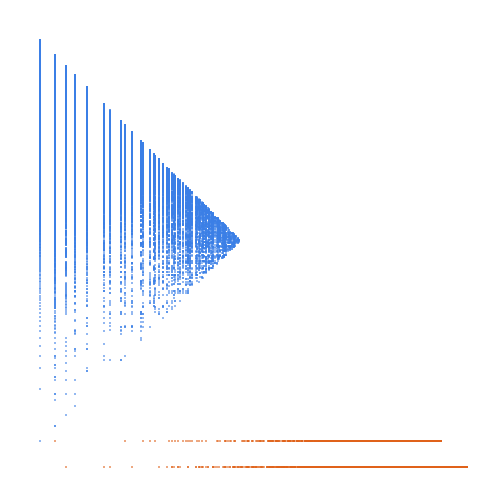
Open in the 3-D viewerA003152 on the OEIS
| Terms | 100,000 (n = 1 … 100,000) |
|---|---|
| Decomposable (a > 2d) | 99,998 |
| Level class, k > L | 12,545 · 12.55 % |
| Weight class, k ≤ L | 87,453 · 87.45 % |
| Ties, k = L | 30 |
| On the level line L = 1 | 9,136 |
| Forced level, l ≤ d² | 1 |
| Range of a(n) | 1 … 170,710 |
| Range of the jump d | 1 … 2 |
| Largest weight k, level L | 170,701, 85,353 |
floor(n(1 + 1/sqrt 2)), the complement of floor(n(1 + sqrt 2)). Gaps 1 and 2. The level share is 12.55 %; L = 1 holds 73 % of the level class.
The decomposition
Every term of a strictly increasing sequence is written a(n) = k(n)·L(n) + d(n): the jump d = a(n+1) − a(n), the weight k the least divisor of a − d greater than d, the level L = (a − d)/k. A term decomposes when a > 2d; it is in the level class when k > L and in the weight class when k ≤ L. See decompwlj.com and arXiv:0711.0865, or how it works, with worked examples and a live one.